Many Codex users are reporting the same frustrating pattern: a task that worked yesterday suddenly requires more retries, misses files, forgets constraints, or produces a shallow patch instead of solving the real problem. Searches for “Codex degradation” and even “Is Codex degradating?” reflect the same concern: has Astra become less capable under heavy load?
At the same time, OpenAI paused new sign-ups and upgrades for the ChatGPT Pro $200 plan, also called Pro 20X, on September 10, 2026. The public explanation connects the decision to extraordinary demand for Astra and the strain that high-usage $200 subscriptions place on available systems.
Taken together, the evidence points to real capacity pressure. But one distinction matters: OpenAI has confirmed capacity constraints, usage windows, and recent service incidents; it has not confirmed that it secretly downgrades the intelligence of existing Codex users. A “dumber Codex” experience can come from congestion, exhausted allowance, a different model or reasoning level, poor task context, or an actual service problem.
If you do not want your workflow to depend entirely on one subscription and one route, YYLX.IO provides another way to connect Astra to Codex and compatible AI clients, subject to the models and groups currently shown in its dashboard.
What does Codex degradation look like?
Users rarely receive an error labeled “reduced intelligence.” Instead, they notice changes in behavior:
- Codex asks about requirements that were already stated.
- It reads a repository but overlooks an important file or dependency.
- A patch compiles without addressing the root cause.
- A long task begins well, then becomes repetitive or ends too quickly.
- The same prompt produces noticeably different quality at different times.
- Astra feels more like a low-reasoning or lighter model than the version used earlier.
These symptoms are real, but a single task cannot prove a hidden model swap. Before drawing that conclusion, check the selected model, reasoning level, remaining usage, context size, service status, and client version.
Why are users more likely to notice Codex degradation now?
1. Astra demand is creating genuine compute pressure
The public announcement shared by the user says demand for Astra has been unprecedented. To protect access for existing users, the platform paused new subscriptions to the most compute-intensive individual tier while adding capacity.
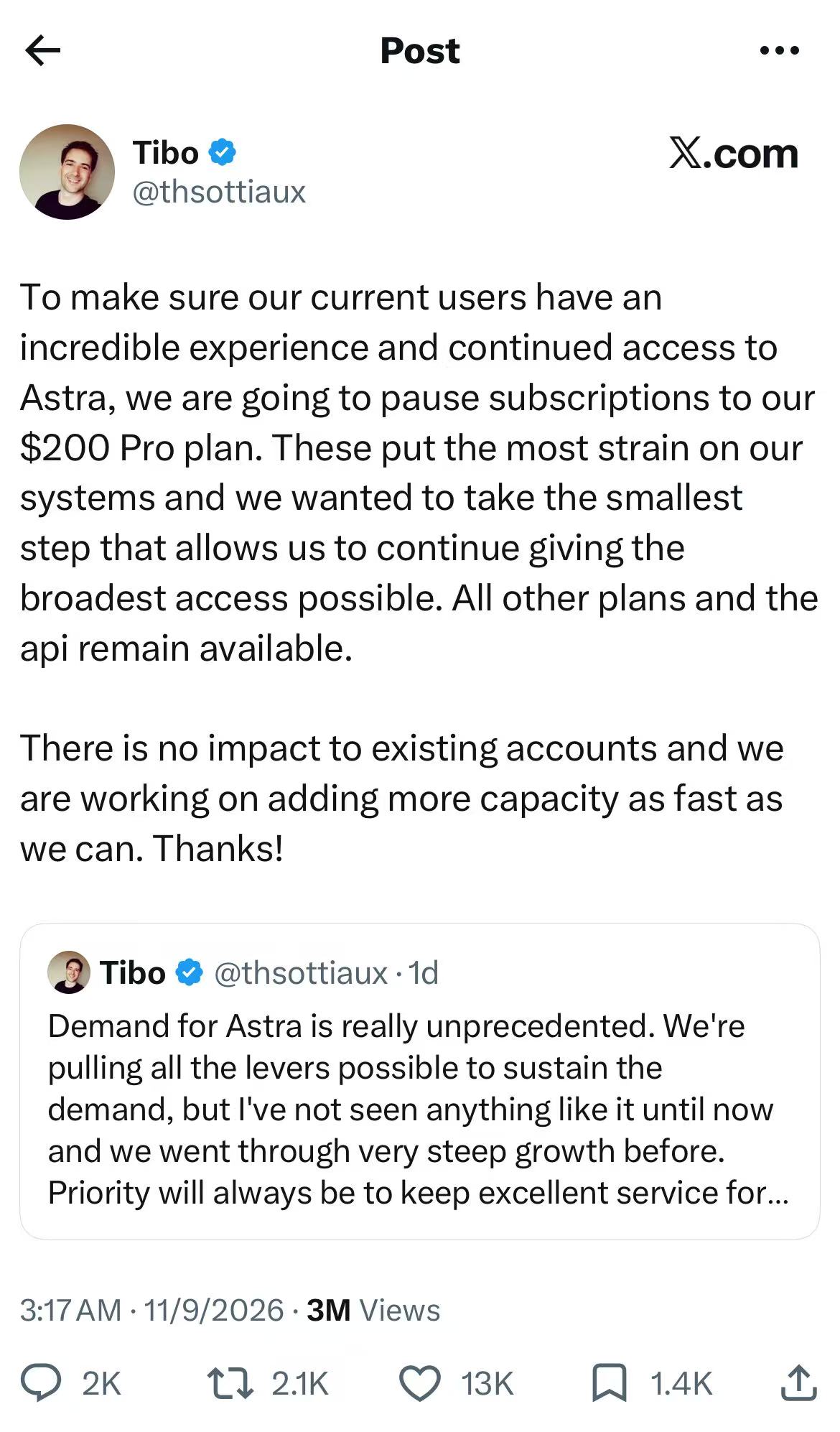
Image: User-provided screenshot of the public announcement linking the Pro $200 pause to Astra demand and system strain. It also states that existing accounts, other plans, and the API remain available.
This does not prove that every weak answer is caused by insufficient compute. It does show that Astra launched into a real supply-and-demand problem rather than an ordinary rollout.
2. OpenAI recently recorded degraded performance for Codex
OpenAI’s status page recorded elevated errors and degraded performance across ChatGPT and Codex on September 3, 2026. That incident was later marked resolved. A status incident is not evidence of permanent intelligence loss, but congestion, tool failures, retries, and interrupted tasks can all make the final experience look much worse.
3. Astra can consume allowance faster than Sol
OpenAI’s documentation says Astra may use the shared Work and Codex allowance faster than GPT-5.6 Sol. Consumption depends on task complexity, input and output size, reasoning settings, and Fast mode.
Work and Codex can be governed by both a five-hour window and a weekly window. If either limit is reached, the user may need to wait for a reset, use a saved reset, purchase eligible credits, or choose another available option. From the user’s point of view, a change in model availability or task behavior after heavy use can easily feel like “Codex got worse after I used it too much.”
4. Reasoning settings and context quality can change the result
Model choice and reasoning level are separate controls. Low, Medium, and higher settings affect how much reasoning the model applies and how quickly allowance is consumed. A client update, workspace change, or new-task default can alter those settings without the user noticing immediately.
Long conversations create another problem. Conflicting instructions, irrelevant logs, stale files, or missing permissions can reduce quality even when Astra is selected. OpenAI also notes that increasing reasoning cannot supply information, files, or access that the model does not have.
Does Codex automatically switch heavy Pro users to a weaker model?
There is currently no official document confirming that Codex silently replaces Astra with a weaker model for existing users. What the official documentation does confirm is:
- Astra uses the Work and Codex allowance included with the account.
- Five-hour and weekly limits may both apply.
- Plus and Business Standard receive limited Astra usage.
- After reaching a limit, users may need to wait, reset, use credits, or select another available option.
- GPT-6 Pro in Chat and Astra in Work/Codex follow different allowance systems.
A more defensible conclusion is: heavy users can encounter a visibly worse experience because capacity, allowance, available models, reasoning settings, or service health changes during use. That feels like degradation, but it is not proof of a secret downgrade.
Is “Codex degradating” the correct English phrase?
“Codex degradating” appears in some user searches and informal discussions, so it is useful for describing what people are looking for. In standard English, however, “Codex is degrading” or “Codex degradation” is more natural. All three phrases usually point to the same complaint: declining output quality, reliability, or reasoning after extended use or during periods of high demand.
Why did OpenAI pause new Pro $200 subscriptions?
Pro $200 is the highest-usage individual ChatGPT tier. Beginning September 10, OpenAI paused new purchases and upgrades from Free, Go, Plus, and Pro $100.
| User | Current status |
|---|---|
| Free, Go, or Plus | Cannot purchase Pro $200 during the pause |
| Pro $100 | Cannot upgrade to $200 during the pause |
| Existing Pro $200 | Can continue using and renewing the plan |
| New Pro $100 customer | Can still purchase Pro $100 |
Existing $200 subscribers should protect their payment method and avoid accidental cancellation or downgrade. Once the plan actually ends, it cannot be repurchased until the pause is lifted. OpenAI has not announced a reopening date.
The pause is the clearest capacity signal in the story: OpenAI is temporarily giving up growth in its highest individual tier to stabilize Astra access and the experience of existing users.
How to check whether Codex is degraded or your task needs fixing
Run through this checklist before abandoning a task:
- Open Settings → Usage and check the five-hour and weekly windows.
- Confirm that GPT-6 Astra is actually selected rather than Sol, Terra, or Luna.
- Check the reasoning level and retry a critical task at Medium.
- Update the ChatGPT desktop app. Astra requires Codex CLI 0.153.0 or later.
- Start a clean task with only the necessary files, goal, constraints, and acceptance criteria.
- Check the OpenAI status page for an active service incident.
- Compare routes with one fixed test task instead of relying on memory.
If a clean task works normally, the original context or instructions were likely part of the problem. If tool calls, timeouts, and skipped steps continue across tasks while service status also shows an incident, capacity or infrastructure is a stronger explanation.
Cannot get Pro $200? Use Astra through YYLX.IO
If your priority is Astra’s coding, research, and problem-solving capability—not the complete ChatGPT web membership—you can review the currently available Astra routes at YYLX.IO.
YYLX.IO is an AI model relay for Codex, ChatGPT-compatible clients, and other tools that accept a custom Base URL and API key. It gives users a model-access path that does not require successfully purchasing a new Pro $200 subscription.
The usual setup is:
- Create an account and sign in to YYLX.IO.
- Add balance and generate an API key.
- Check the dashboard for a group that currently supports Astra and note the exact model name.
- Enter the Base URL, API key, and model name in Codex or another compatible client.
- Test speed, tool calls, and code quality with a small fixed task before moving production work.
A relay cannot promise that an upstream model will never fluctuate. Its practical value is route flexibility. When Pro $200 is unavailable, an account reaches its allowance, regional payment is difficult, or an official route feels unstable, users have another way to reach the model without rebuilding their entire workflow.
Groups, rates, model names, and availability can change, so the live YYLX.IO dashboard is the source of truth. YYLX.IO credit is also not a ChatGPT Pro membership. It does not unlock ChatGPT web history, memory, voice, or other subscription benefits on an official account.
Who benefits most from a relay route?
- Users who cannot upgrade during the Pro $200 pause but need Astra now.
- Developers who depend on Codex and want a second model route.
- Teams that need model/API capability rather than ChatGPT membership features.
- Users connecting models to an IDE, CLI, automation, or internal tool.
- Anyone who wants more flexibility across models and routes.
Final takeaway: “Codex degradation” is a capacity, allowance, and workflow problem
The feeling that Codex has become less capable is worth investigating, but it should not be reduced to an unsupported claim that OpenAI secretly swaps models. The confirmed facts are already significant: Astra demand has created visible capacity pressure, new Pro $200 sign-ups are paused, Astra can consume Work/Codex allowance quickly, and OpenAI has recently recorded degraded Codex performance.
Existing users should check usage, model selection, reasoning level, client version, and task context. If you cannot buy Pro $200 or want a backup model-access route, visit YYLX.IO and review the Astra groups currently available for Codex and compatible clients.
发表回复